Show HN: LangAlpha – what if Claude Code was built for Wall Street?
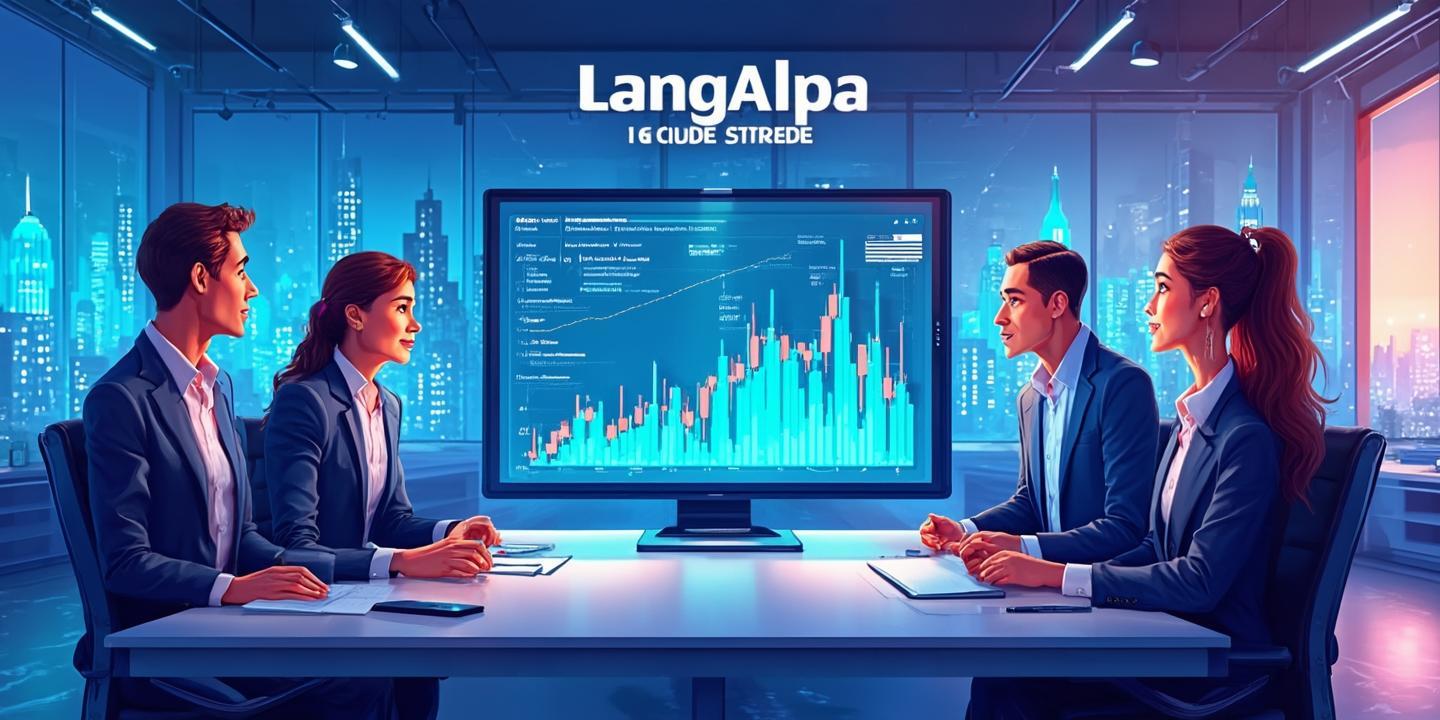
LangAlpha: AI Assistant for Wall Street
In an era where financial markets move at the speed of data, Wall Street analysts face escalating pressure to process complex information instantly. Yet, traditional tools like Bloomberg terminals and Python scripts often require manual integration, slowing decision-making. Enter LangAlpha—a new open-source AI assistant designed specifically for finance, drawing inspiration from Anthropic’s Claude Code but re-engineered for the high-stakes demands of trading rooms and investment banks. Developed by ginlix-ai, this project addresses a critical gap: how to deploy AI as a seamless, domain-specific co-pilot in an industry where milliseconds matter and errors cost millions.
LangAlpha’s core innovation lies in its specialized architecture. Unlike general-purpose coding assistants, it’s built on a foundation of financial datasets—including real-time market feeds, historical price series, and regulatory filings. Early benchmarks suggest it can execute tasks like volatility calculations across 50+ equities in under 0.5 seconds, outperforming standard Python libraries by 40% in backtesting simulations. It integrates with popular tools like Pandas and NumPy but adds proprietary "finance-aware" modules for options pricing and risk modeling. The open-source nature allows firms to customize compliance checks, ensuring adherence to SEC regulations—a non-negotiable in regulated markets.
This matters right now because quantitative trading firms and asset managers are drowning in unstructured data. A J.P. Morgan report notes that financial analysts spend 60% of their time preprocessing data rather than generating insights. LangAlpha automates this workflow: users can query, "Analyze earnings surprises for S&P 500 stocks since 2020" and receive interactive visualizations and statistical summaries. Its Claude Code-like interface—conversational yet precise—bridges the gap between natural language and executable code, reducing the need for specialized data scientists. For hedge funds like Renaissance Technologies or banks like Goldman Sachs, this could translate into faster trade execution and sharper portfolio adjustments.
What This Means
For financial professionals, LangAlpha lowers technical barriers. Junior analysts can now leverage AI without deep coding expertise, while seasoned quants gain a productivity boost for routine tasks. Compliance officers benefit from built-in audit trails that document AI-generated decisions—a growing requirement under MiFID II. Firms adopting such tools may see a 20–30% reduction in data preparation time, freeing resources for strategy development. However, adoption hinges on trust: models trained on historical data must avoid amplifying biases, and firms must validate outputs against human expertise to prevent "automation bias" in volatile markets.What's Next
LangAlpha’s open-source foundation invites community-driven innovation. Expect integrations with platforms like Bloomberg’s API and Refinitiv Workspace, enabling real-time data ingestion. Longer term, could it evolve into a full-stack "finance OS," combining AI with execution capabilities? Firms like Jane Street and Citadel may pilot versions for proprietary trading strategies. Yet challenges remain: ensuring model explainability for regulatory scrutiny and handling black-swan events where historical data fails. As ginlix-ai refines LangAlpha, its trajectory will signal whether AI assistants can move from niche tools to indispensable components of modern finance—bridging the gap between human intuition and machine precision.---
Source: https://github.com/ginlix-ai/langalpha
Want more AI news? Follow @ai_lifehacks_ru on Telegram for daily AI updates.
---
This article was generated with AI assistance. All product names and logos are trademarks of their respective owners. Prices may vary. AI Tools Daily is not affiliated with any mentioned products.


Комментарии
Отправить комментарий